TRACES OF LIFE BENEATH THE CANOPY OF KEHJE SEWEN FOREST
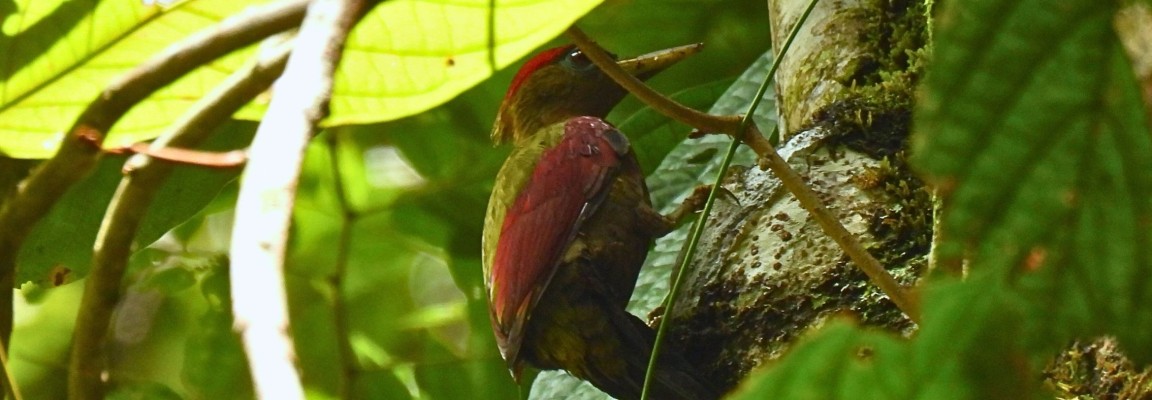
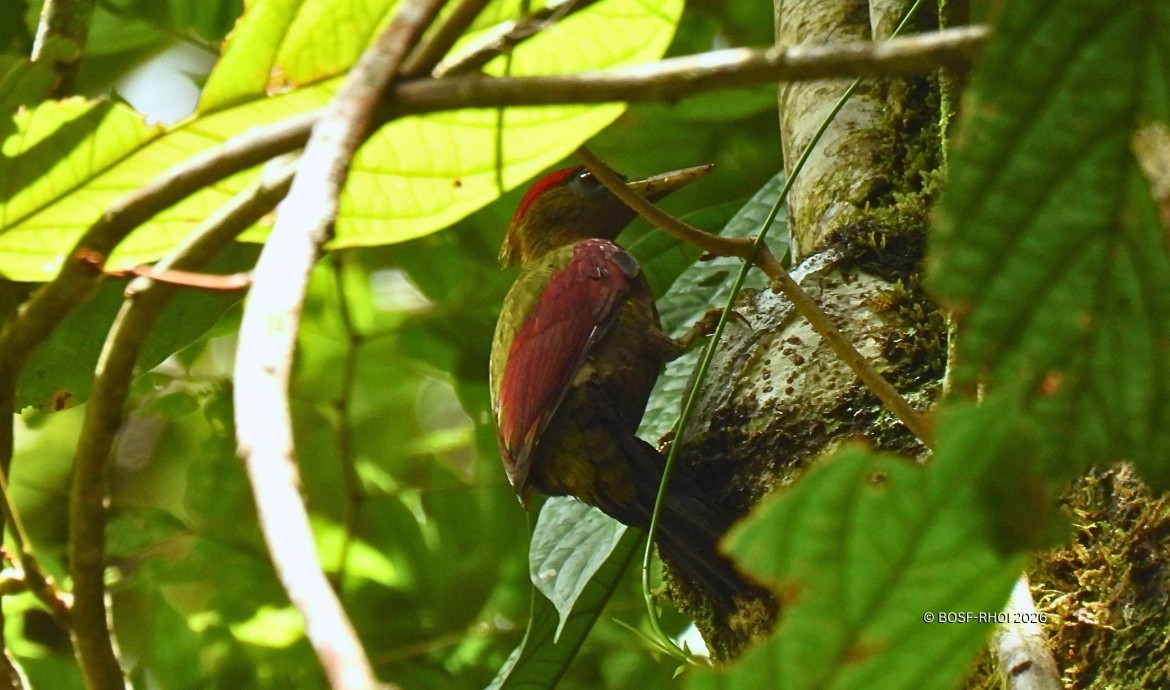
During routine patrols in the Kehje Sewen Forest, East Kalimantan, our Research & Biodiversity–Post Release Monitoring (PRM) Team of PT. RHOI had the opportunity to document the presence of a Crimson-winged Woodpecker (Picus puniceus). This brief encounter serves as a reminder that the same forest supporting orangutan life is also home to a wide array of other wildlife species that often go unnoticed.
Getting to Know the Crimson-winged Woodpecker (Picus puniceus)
The Crimson-winged Woodpecker is a member of the Picidae family and is easily recognized by its striking yet well-camouflaged coloration that blends seamlessly with its surroundings. This medium-sized woodpecker measures approximately 30–33 cm in length. Olive-green plumage dominates its back and body, while its wings display distinctive brick-red patches. Thus features that inspire its common name, “crimson-winged.”
Its head is adorned with bright red feathers, particularly prominent in males, and is complemented by a strong, straight, and sharply pointed bill. This bill is a vital tool used for probing tree trunks in search of food as well as excavating nesting cavities. The bird’s sturdy legs and specialized toe arrangement enable it to cling firmly to tree trunks, even on vertical surfaces.
Habitat and Distribution
The Crimson-winged Woodpecker has a relatively wide distribution across Southeast Asia, including the Malay Peninsula, Sumatra, and Borneo. In Indonesia, it is commonly found in lowland to hill tropical rainforests, particularly in areas that still retain dense forest cover and large trees.
Within Kehje Sewen Forest, the presence of this species reflects the continued integrity of the habitat. Forests with complex vegetation structures provide abundant food sources and primary trees that are essential for nesting and shelter.
Feeding Habits and Daily Behaviour
Like most woodpeckers, the Crimson-winged Woodpecker relies primarily on insects as its main food source. It is often observed pecking at tree trunks in search of ants, beetles, termites, and insect larvae hidden beneath the bark. When insect availability declines, it may also supplement its diet with forest fruits.
This species tends to live solitarily or in pairs, foraging calmly and with focused precision. The rhythmic tapping of its bill against tree trunks is often the first sign of its presence amid the dense forest.
Breeding Behaviour
During the breeding season, Crimson-winged Woodpeckers excavate nesting cavities in dead or old trees with relatively soft wood. Nest construction is carried out cooperatively by both the male and female. The female typically lays 2–4 eggs, which are incubated alternately by both parents.
The chicks remain inside the nest cavity until they are strong enough to fly and forage independently. Abandoned woodpecker nest holes play an important ecological role, as they are frequently reused by other bird species and small animals as shelter.
Conservation Status and the Importance of Habitat Protection
According to the International Union for Conservation of Nature (IUCN) Red List, the Crimson-winged Woodpecker (Picus puniceus) is currently classified as Least Concern (LC). Nevertheless, the species’ long-term survival remains closely tied to the preservation of its forest habitat. Deforestation, forest degradation, and land-use conversion pose ongoing threats by reducing available habitat and food resources.
The presence of the Crimson-winged Woodpecker in Kehje Sewen Forest is more than a record of biodiversity. It is a reflection of a forest ecosystem that continues to function effectively. Alongside orangutans, small mammals, and numerous other bird species, Picus puniceus forms part of an interconnected web of life that depends on the continued protection of this vital forest landscape.